home | 1900 | 1925 | 1930 | 1937 | 1941 | 1945 | 1946 | 1949 | 1952 | 1956 | 1960 | 1969 | 1978 | greenwich | info
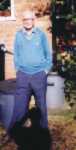
< Click to enlarge - Alf in my garden in Kings Heath, Birmingham, 17th October 1999
Of course, those of us that believe wholeheartedly in synchronicity (and don't ask me to define that here...) will smile sadly at the following.
On the day my dad had his central line fitted, even as the hospital staff
were putting it into his neck to feed him, I bought a copy of the Guardian newspaper
from the hospital shop.
In that day's edition was this:
No 31: Cancers of the stomach, oesophagus and pancreas.
Almost one in 10 cancers strike the upper gastrointestinal (UGI) system
(the stomach, oesophagus or pancreas). Most sufferers are elderly, although
younger people are occasionally affected. Prognosis is generally poor
- only about a quarter of UK patients survive a year after diagnosis.
International studies show better survival rates elsewhere.
Diagnosis
Early diagnosis is difficult. Typical symptoms - such as dyspepsia, nausea
and stomach pains - are common to many other, less serious, complaints.
Government guidelines stipulate patients should have investigations within
two weeks if they show symptoms including jaundice, dysphagia (when foods
sticks on swallowing), or dyspepsia, when combined with other warning
signs such as weight loss or family history of UGI cancer. Anyone with
suspected oesophageal or stomach cancer should have an endoscopy; ultrasound
is best for suspected pancreatic cancer.
Treatment
For stomach cancer, the UK's five year survival rate of 12% is almost
half the 21% European average. Later diagnosis and poorer hospital care
seem to be key reasons. A major study of UGI cancer care in 29 hospitals
in England and Wales found doctors who saw more patients had lower death
rates. The trend is confirmed in US studies. Surgery to remove the cancerous
area is the main treatment when cancer is diagnosed early enough, but
it is risky. Patients often die within one month. A large study has shown
that chemotherapy before surgery for oesophageal cancer improves survival
by 10% after two years. Combining chemotherapy with surgery for stomach
cancer has a slight benefit, according to analysis of several studies.
Radiotherapy seems to help only a minority of patients with oesophageal
cancer. For most people, palliative care to relieve symptoms is the main
need. Inserting metal tubes can help swallowing.
Wendy Moore
What works? is based on reviews of the most up-to-date and reliable evidence
available. It is written in collaboration with the NHS Centre for Reviews
and Dissemination at York university (01904 433 634) and verified by experts.
Details can be seen on the CRD website www.york.ac.uk/inst/crd
©2001 Guardian Newspapers
And finally, here's something I can across around the time that my dad died, that brought it all home to me - we're all the same, eh?
More about his passions, like poetry, music, and flamenco dancing.
More about his compulsions, like keeping documents, no matter how unimportant, for over forty years.
More about his caring, like letters sent from clients, thanking him for being there through difficult times.
More about how he loved us. Because in those boxes were cards we'd given him throughout his life and remembrances of his children's achievements.
And, it was then, standing silent over those boxes, as tears and dust mixed upon my face, that I wondered what my children would find in my boxes when I'm gone.
Would they puzzle over the clothes that I used to wear on stage when I played in a rock band?
Would they argue over who would keep the blue Plexiglas peace sign I bought at a garage sale?
Would they be amazed at how many pictures I had of their mom?
Would they remark at how odd it was that I loved reading, writing, and music, just like my dad?
And, most of all, as they looked at the stories I'd written, would tears and dust mix upon their faces as they realized how much I loved them?
What will be in your boxes?
By Jim R. Warda
Sheed and Ward © 2001. All rights reserved.
Mike says - found in my dad's boxes:
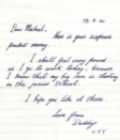
Click each thumbnail to enlarge

This work is licensed under a Creative Commons Attribution-Noncommercial-No Derivative Works 2.0 UK: England & Wales License.
Text by Alf Allen 1999. Edited and spell-checked by Mike Allen 2003.
Most photos taken by Alf and most illustrations drawn by him; scanned from
his albums, etc., now in my possession and digitally edited 2003-2005.
Yes, yes, the photos and layout need updating - the website was first designed in "dial-up days", before any sort of broadband, and everything had to be small so it uploaded and downloaded fast. Work to do, I know.
Website produced 2003-2013 by Mike Allen - a fatuous platitudes production.
Attempting accessibility:

Last changed 28-Aug-2013 22:54